
Haryana Chief Minister Nayab Singh Saini has criticised Congress leaders for visiting 'anaj mandis' in Haryana and challenged them to assess the performance of Congress-governed states. He highlighted the development work carried out in Haryana under the current government.

Trinamool Congress leader Abhishek Banerjee accuses the central government of withholding funds from West Bengal to punish voters for supporting the TMC, while highlighting state-led initiatives to support the population.

Union Education Minister Dharmendra Pradhan advocates for the establishment of 'Mahakal Standard Time' based on Ujjain's historical significance in time calculation, challenging the dominance of Greenwich Mean Time.

The United States has encouraged India to purchase Russian oil already at sea to mitigate supply shortages and price increases amid the West Asia conflict, according to Energy Secretary Chris Wright. This move is described as a short-term effort to stabilise the market without altering Washington's policy towards Russia.
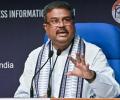
Union Education Minister Dharmendra Pradhan has advocated for the establishment of 'Mahakal Standard Time' (MST), citing Ujjain's historical significance as a centre for time calculation and astronomy.

A global water report promotes privatisation narrative which could be disastrous for India and the world, says Gopal Krishna.

Prime Minister Narendra Modi and West Bengal Chief Minister Mamata Banerjee engaged in a war of words during election rallies, with Modi accusing the TMC of supporting divisive forces and Banerjee alleging the BJP plans to divide the state.

The first-ever Khelo India Water Sports Festival is all set to reveal the iconic Dal Lake in a new avatar.

'Torpedoes travel at more than 100 kilometres per hour, about 50-60 knots.' 'It must have been a matter of a few minutes before it detonated under the Iranian ship.' 'The Iranian ship would have probably got three, four minutes and wouldn't have known till they actually heard the whirr of the torpedo.'

Union Home Minister Amit Shah criticised the Congress party for its alleged inaction in addressing Maoist violence during its long rule, while highlighting the Modi government's success in nearly eradicating Maoists from Bastar, Chhattisgarh.

Both sides have now revealed a preference for escalation over strategic defeat, and each new provocation narrows the space for the next pause. The Touska seizure, Iran's refusal to negotiate under blockade, Israel's strikes on Iranian oil infrastructure -- all of these add up to an increasingly untenable situation. This makes the wild card -- Trump and his motormouth -- more consequential than ever, notes Prem Panicker in his must read blog on the Iran War.
The US has temporarily permitted India to accept Russian oil already on ships to ensure energy supplies amid the conflict with Iran. This short-term measure is not expected to significantly benefit Russia financially.

Chief Secretary Atal Dulloo emphasises the importance of holistic development and grassroots governance for India's progress at a national conference in Jammu.

The Bastar region of Chhattisgarh, India, is transitioning away from decades of Maoist conflict, with plans to convert security camps into public infrastructure. A senior Maoist commander recently surrendered, marking a significant step in the government's efforts to eliminate Naxalism.

The LPG squeeze on India's restaurant sector is the quotidian face of a deeper crisis.

India's handling of the Iran crisis reflects a growing strain between strategic autonomy and geopolitical alignment, observes Ambassador M K Bhadrakumar.

Trump may strike. He may announce productive talks and extend again. He may do both at the same time. Iran will not open the Strait on someone else's terms, so no matter what happens, that problem will remain unsolved. And the IRGC will still be collecting its $2 million toll from every ship bold enough to ask permission to pass.

The Union Cabinet, meeting at the new PMO complex 'Seva Teerth', resolved to prioritize citizen empowerment and service in all its decisions, guided by the principle of 'Nagrik Devo Bhava'.

India should resist knee-jerk responses to tariff volatility in the US and instead use the current geopolitical churn to build manufacturing scale at home, former G20 Sherpa and former chief executive officer of NITI Aayog Amitabh Kant said on Wednesday.

The purge in Washington does not pause the war. Strikes continue, Hormuz remains closed, and Brent crude is still dancing around $109 a barrel. For India, the command chaos in the Pentagon is another layer of uncertainty piled on five weeks of conflict that was already straining every buffer Delhi has.

Fight on toward goals that keep receding, or exit with most objectives unmet. Trump is agitated, his poll numbers falling below the Plimsoll line, his base fractured between those who back the war and those who remember that he campaigned on ending them.

For weeks, the war skirted the edge of catastrophe without tipping over. Missiles flew, there was much destruction, commanders were assassinated, cities across the Gulf and even in Israel struggled to absorb the shock. But one line held: Energy infrastructure, the arteries of the global economy, remained largely untouched. That is no longer true. Prem Panicker continues his must read daily blog on the Gulf War.
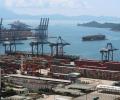
With the Iran war escalating sharply and crisis deepening in the global energy market, India on Monday unveiled a coordinated plan to support exporters and shippers caught in the fallout.

The 'rescue' operation occurred within kilometres of Iran's underground tunnel complex at Isfahan, assessed by the IAEA and US intelligence as holding a substantial portion of the country's 60 per cent enriched uranium stockpile. Retired senior US military officers have highlighted that the mission's footprint -- hundreds of special operators, multiple heavy-lift aircraft deep inside Iran -- appears outsized for recovering a single airman. Prem Panicker continues his must read blog on the Iran War.

The delegations from the US and Iran head to Islamabad on Friday, carrying a ceasefire that is already fraying, a Strait that is technically open and practically closed, and a negotiating agenda that would challenge even parties actually negotiating in good faith, which these groups are not. Prem Panicker continues his must read blog on the Iran War.

India's Permanent Representative to the UN, Ambassador Parvathaneni Harish, delivered a sharp response to comments made by Pakistan's Ambassador to the UN, Asim Iftikhar Ahmad.

The Trinamool Congress (TMC) has announced a 60-day mass outreach program targeting Scheduled Caste and Scheduled Tribe-majority assembly constituencies in West Bengal, accusing the BJP of depriving the state of funds and disrespecting marginalized communities.

'It is best to remain vigilant. Tarique Rahman arranged arms smuggling to Indian insurgent groups.' 'He has criticised India for sheltering Sheikh Hasina, but has also sought India's support.'

The Congress party has accused Union Minister Nitin Gadkari of conflict of interest, alleging his sons' companies have benefited from the government's ethanol blending policy. The BJP has rejected the allegations.

'No, India and China were not about to go to all-out war over a few rocks of Galwan.' 'The full picture of what went on at the highest level between two heads of State will not be known for a very, very long time and rightly so,' points out Colonel Anil A Athale, former head of the history division, ministry of defence.

The United States, which entered this war in expectation of a short, sharp win along the Venezuela model, is now preparing for deeper involvement in a conflict it does not fully control, without the allies it typically relies on, against an adversary that is not behaving as expected, in a global environment that is already absorbing economic shock. Prem Panicker continues his must read daily blog on the Gulf War.

In a region increasingly shaped by competition and coercion, such collaboration strengthens security without confrontation, builds capacity without dependency and promotes order without domination, points out Dr Kumar.

Sustaining 8 per cent-plus growth rates is necessary if we are to reach high-income status by 2047, points out Amitabh Kant.

India is aiming to win multiple medals in disciplines like aquatics and cycling at the 2036 Olympic Games as both these events offer over a 100 medals.

Bangladesh's newly-elected Prime Minister Tarique Rahman pledged to strengthen the rule of law and ensure the country is a safe land for people of all faiths, while also addressing corruption and improving law and order.

In the Indo-Pacific's new era -- where perception shapes reality faster than treaties -- the real entrapment is not of China or the United States. It is the test Japan has set for itself -- and whether partners like India, acting as balancers rather than accelerants, can help ensure that the story ends in stability, points out Varun Arya.

The Maharashtra municipal elections showed a troubling shift, where votes were traded for cash, convictions no longer mattered, and ideology became an afterthought, observes Ramesh Menon.

'A poor candidate was given a chance so that the concerns of ordinary, needy citizens could be represented.'

Sonia Gandhi criticizes the Modi government's environmental policies, claiming they endanger the Aravalli hills and disregard environmental protection.

Mundane as it may seem, this is in some ways a metaphor for the challenges facing the nation, argue Arvind Subramanian and Devesh Kapur in their new book, A Sixth Of Humanity.
